The Anatomy of Modern Web Architecture

The web development ecosystem is undergoing a radical evolution driven by escalating demands for performance, elasticity, and security. The sluggishness of monolithic Content Management Systems (CMS), their heavy server-side processing overhead, and an endless stream of plugin vulnerabilities have pushed modern engineering toward more agile, lightweight, and secure architectures.
For engineers architecting high-traffic e-commerce platforms or embedding DevSecOps into continuous delivery pipelines, architectural decisions now go far beyond "which programming language should we write?" In this guide, we break down the journey from legacy CMS setups to Static Site Generators (SSG), dissect modern rendering paradigms, and analyze modern web infrastructure as a comprehensive engineering anatomy problem.
Why Are We Moving Away from cPanel-Centric Thinking?
For decades, the backbone of the web was the LAMP stack—Linux, Apache, MySQL, and PHP—and traditional monolithic CMS engines like WordPress built atop it. However, a traditional CMS must connect to the database, query tables, parse templates, and assemble HTML on the fly for every single incoming HTTP request. This "Just-in-Time" compute model creates severe server bottlenecks during traffic surges while exposing a massive attack surface to SQL Injection and server-side Remote Code Execution (RCE) flaws.
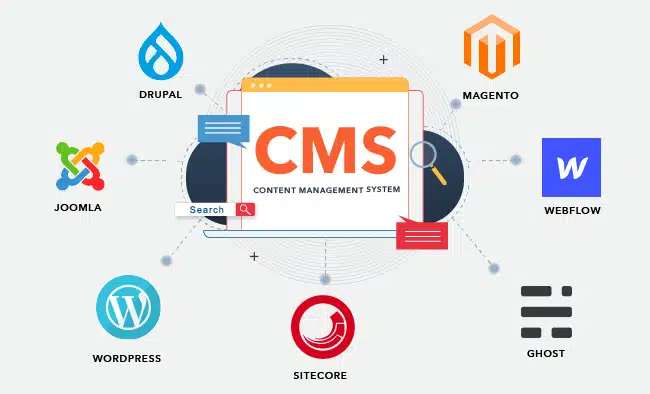
Traditional monolithic architecture flow: Tight database and server coupling causes performance bottlenecks.
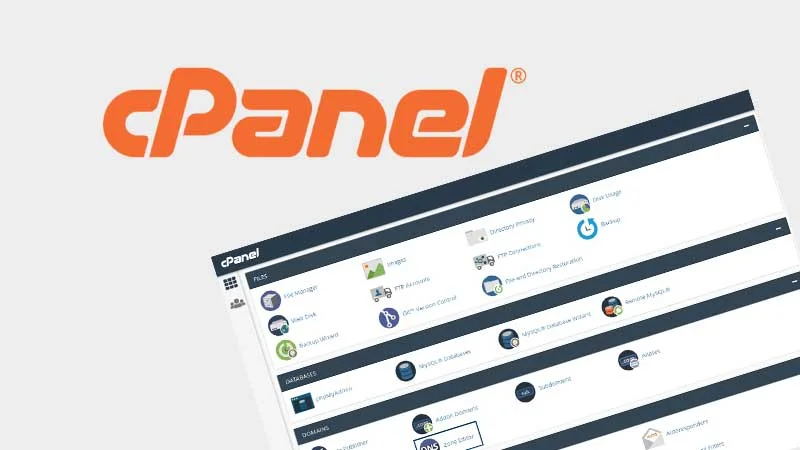
Classic cPanel environment: Convenient, but carries an expansive "server management" attack surface.
Traditional shared hosting control panels (cPanel, Plesk) may seem convenient, but they incur three compounding operational costs:
Plesk: Another panel-centric hosting model sharing the identical architectural trade-offs of cPanel.
- Performance Cost: Dynamic calculation and database latency on every request. When a user requests a page, PHP wakes up, executes database queries, and compiles the DOM. In a world where milliseconds directly dictate conversion rates, this latency is an unacceptable drag.
- Security Cost: An expansive attack surface generated by the control panel + themes + community plugins + the web runtime. Every unnecessary dynamic dependency introduces cyber risk.
- Operational Cost: Continuous patch management, database backups, version incompatibilities, and uptime monitoring overhead.
The core motivation for abandoning legacy server management is clear: instead of managing servers, modern web engineering focuses on serving pre-computed results directly from the edge (CDN).
The Anatomy of Rendering: CSR, SSR, SSG, ISR
How an application draws its interface dictates how the infrastructure will withstand heavy traffic spikes without collapsing. Modern web engineering is anchored across four primary rendering strategies based on where and when HTML is generated:
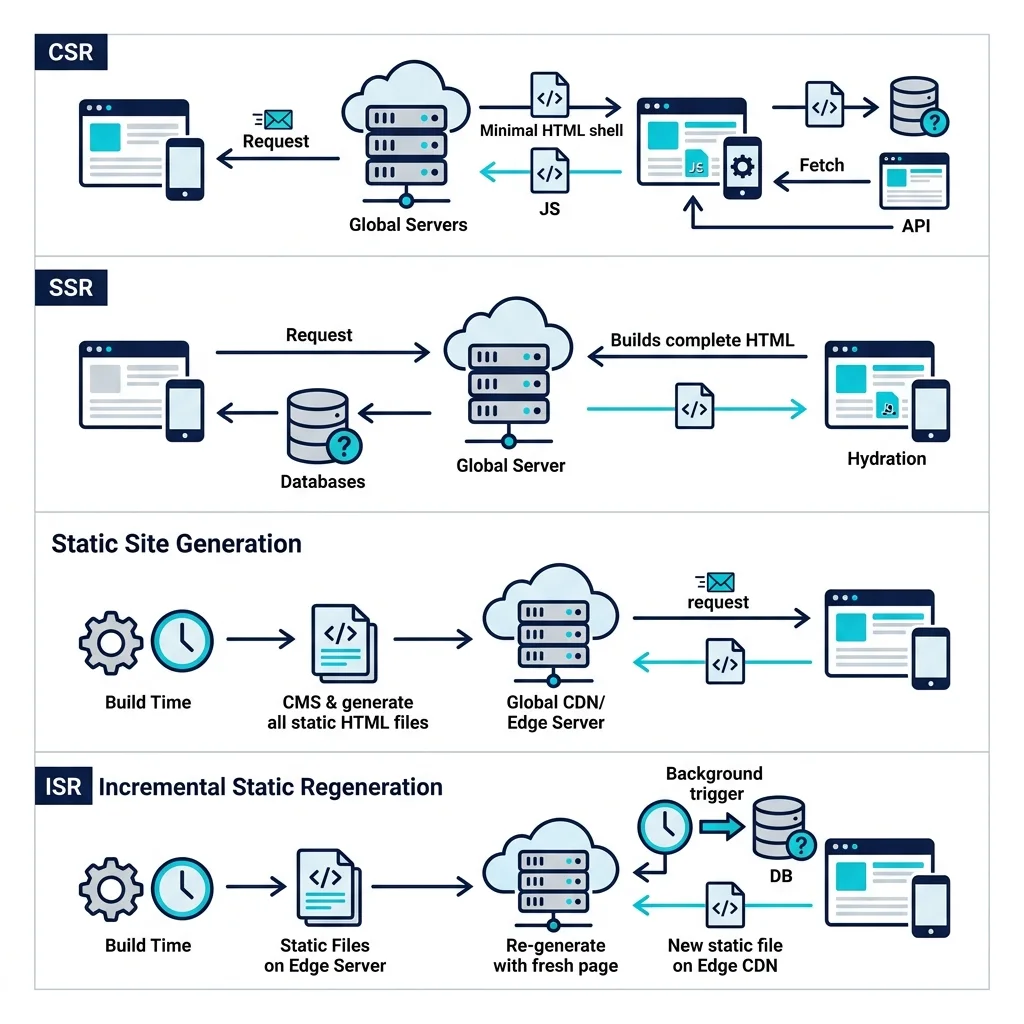
Modern rendering architectures: Data flow models for CSR, SSR, SSG, and ISR.
Client-Side Rendering
The server delivers an empty HTML skeleton. Page construction is executed inside the browser via client-side JavaScript.
- First View: Bound to downloading and parsing JavaScript bundles (SPA feel).
- SEO: Requires search engine rendering support and hydration tuning.
- Ideal Use Case: Internal administration dashboards, authenticated portals, and SaaS consoles.
Server-Side Rendering
HTML is rendered on the server dynamically for every single user request using live data.
- First View: Excellent for SEO indexing and rapid First Contentful Paint (TTFB-sensitive).
- Security: Backend API secrets stay on the server and never reach the client.
- Ideal Use Case: Dynamic inventory catalogs, live pricing, and personalized user feeds.
Static Site Generation
Pages are compiled once at build time and distributed as immutable assets across global CDNs.
- Security: Databases and server runtimes are completely decoupled; attack surface is zero.
- Speed: Sub-second global load times with zero origin database load.
- Ideal Use Case: Documentation sites, company portals, and cybersecurity blogs.
Incremental Static Regeneration
Merges static generation speeds with dynamic freshness. Regenerates individual pages in the background without rebuilding the entire project.
- Advantage: Eliminates multi-hour build queues across enterprise-scale catalogs.
- Performance: Delivers dynamic data with static cached response latency (stale-while-revalidate).
- Ideal Use Case: Large-scale e-commerce stores and high-velocity news portals.
Hybrid Architectures and the "Islands" Pattern
For complex platforms, hybrid models are essential. The Islands Architecture—championed by frameworks like Astro—defaults to "Zero JavaScript" (pure HTML and CSS). Dynamic interactive components (search modals, shopping carts, comment threads) are loaded as isolated, self-hydrating "islands" only when needed. Meanwhile, high-speed static site generators like Hugo and mdBook leverage Go and Rust to compile thousands of Markdown pages in mere seconds.
Architectural Decision Matrix: Which Pattern Fits Your Project?
Selecting the optimal rendering pattern determines your system's operational viability:
- Is content authored primarily by editors or in Markdown?
- Yes: Prioritize SSG (Astro / Hugo). Deployments hosted on static environments like GitHub Pages fundamentally eliminate remote code execution.
- No, data changes dynamically on user actions: Adopt SSR or ISR (Next.js / Nuxt).
- Are personalized, authenticated sessions required?
- Yes: Deploy a hybrid setup (SSR + Edge Caching + Edge Middleware).
- No: Maximize throughput with SSG + isolated island hydration.
- Does the team have limited operational infrastructure bandwidth?
- Yes: Pure static architectures on serverless CDN platforms (Cloudflare Pages, Vercel) eliminate OS patching and server triage.
- No: Containerized microservices on Kubernetes can be justified.
- Is publishing velocity continuous (minute-by-minute updates)?
- Yes: ISR or on-demand cache revalidation is the natural fit.
- No: Pure Static Site Generation delivers unbeatable simplicity and resilience.
Technology Stacks: Architectural Comparison
Engineering success stems from choosing toolchains that balance speed, security, and long-term maintainability.
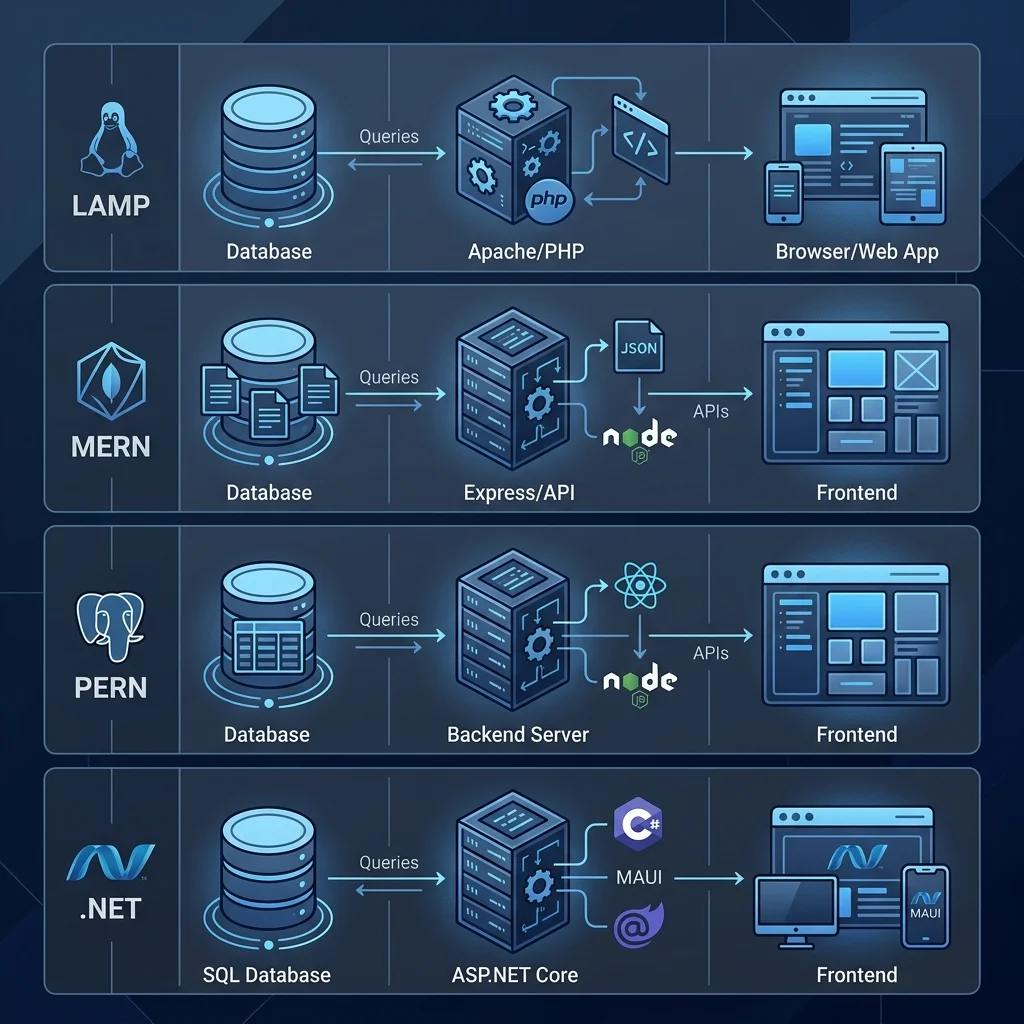
The LAMP Stack (Linux, Apache, MySQL, PHP)
The monolithic workhorse that powered the early web and remains the foundation of traditional CMS platforms:
- Architecture: Traditional Server-Side Rendering (SSR). Apache catches requests, invokes PHP to query MySQL, and returns compiled HTML.
- Strengths: Universal hosting support, low barrier to entry, and exhaustive online troubleshooting libraries.
- Risks: Difficult to scale horizontally during sudden traffic spikes; outdated third-party plugins remain notorious vectors for SQLi and RCE.
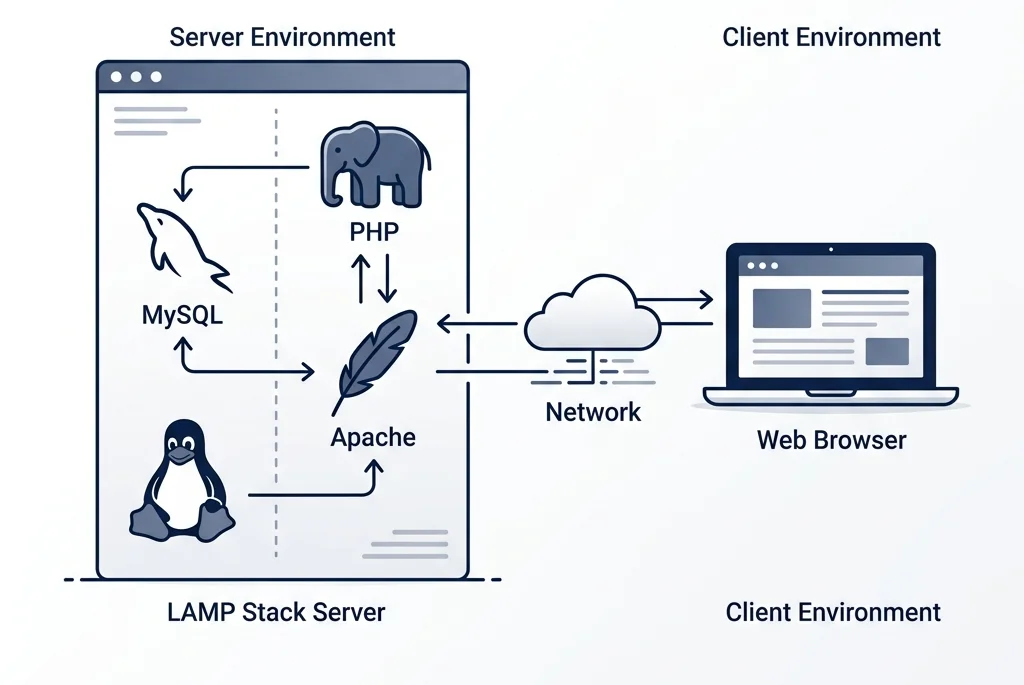
LAMP Architecture: Monolithic SSR operation across Linux, Apache, MySQL, and PHP.
MERN / MEAN (MongoDB, Express, React/Angular, Node.js)
The unified JavaScript/TypeScript ecosystem across both client and server:
- Architecture: RESTful or GraphQL APIs powering client-rendered SPAs or SSR meta-frameworks.
- Strengths: Rapid prototyping, schema-less NoSQL flexibility, and native support for real-time WebSocket communication.
- Security (Supply Chain Risks): Deep NPM dependency trees expose projects to upstream supply chain attacks, demanding rigorous lockfile pinning and automated vulnerability scanning.
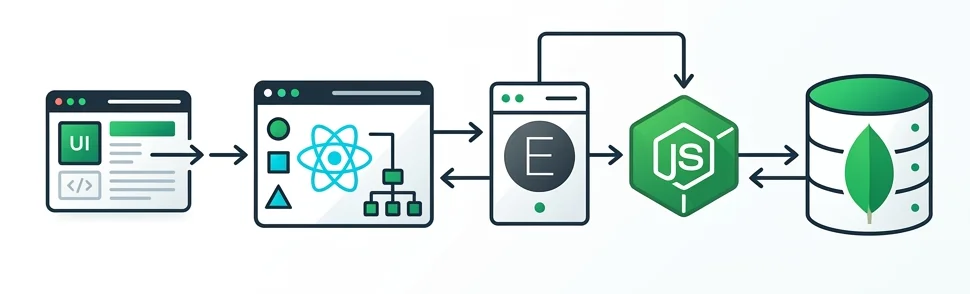
MERN Architecture: Document database storage with unified JavaScript across server and client.
The PERN Stack (PostgreSQL, Express, React, Node.js)
The preferred stack for transactional integrity, financial workflows, and enterprise e-commerce:
- Architecture: Replaces NoSQL with PostgreSQL, the most advanced open-source relational database.
- Why Choose PERN? Enforces strict ACID compliance. If a payment checkout fails mid-flight, database transactions automatically roll back, preventing orphan state.
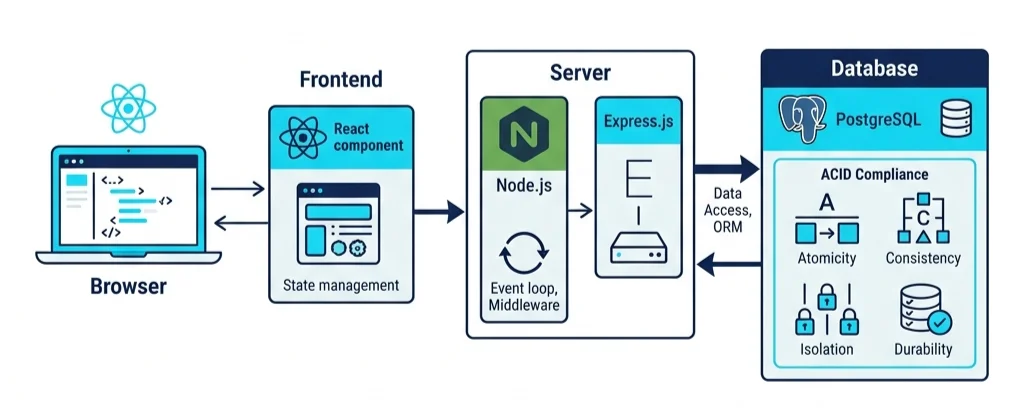
PERN Architecture: Relational database consistency and transaction guarantees via PostgreSQL.
The JAMstack (JavaScript, APIs, Markup)
Decouples frontend delivery completely from backend services:
- Architecture: Pre-rendered HTML is compiled at build time by calling microservices or Headless CMS APIs, then served from global CDNs.
- Security Posture: There are no origin database listeners or application servers exposed to the public internet, eliminating typical web intrusion vectors.
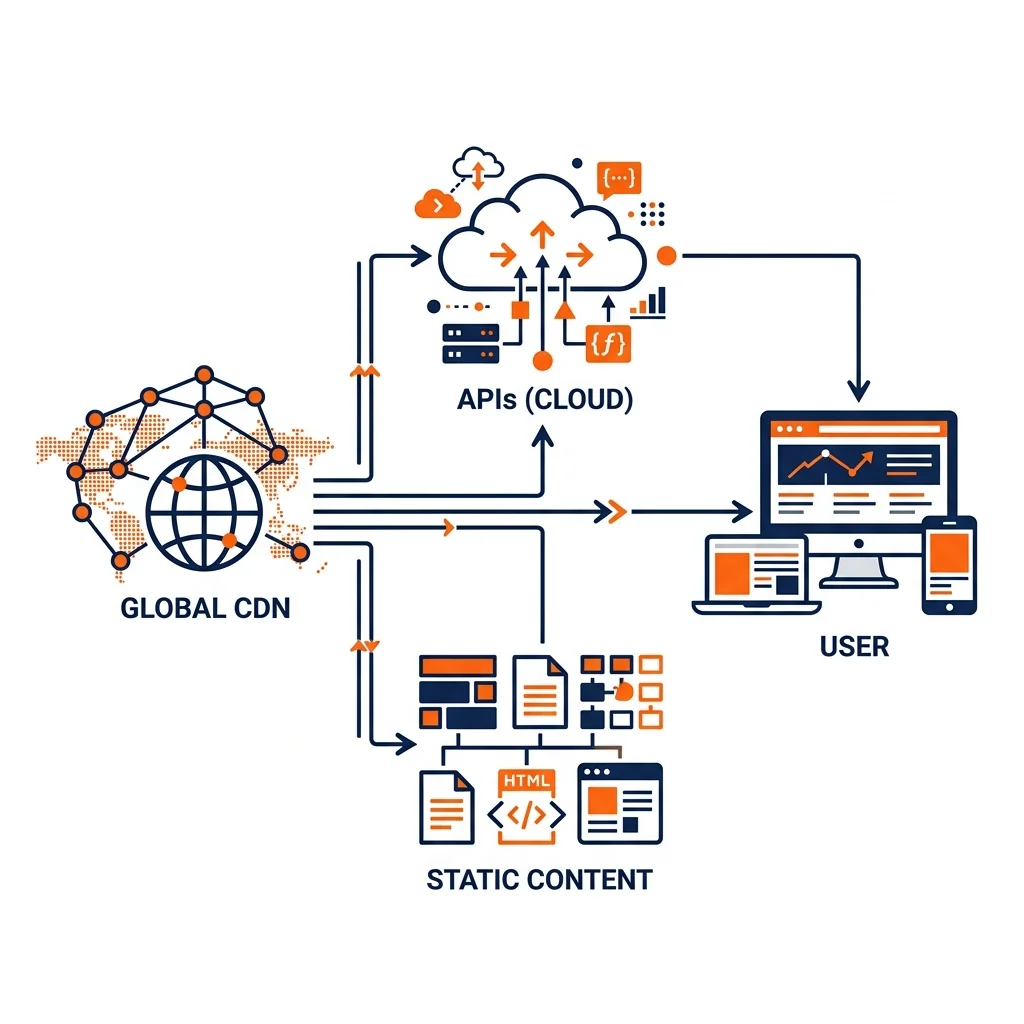
JAMstack Architecture: Decoupled pre-rendering and serverless API integration distributed via CDN.
Modern .NET (C#, ASP.NET Core, Entity Framework Core)
The high-performance, cross-platform enterprise benchmark:
- Architecture: Strongly typed C# powering ASP.NET Core Minimal APIs and multi-threaded background workers.
- Performance & Governance: Where single-threaded Node.js runtimes face CPU bottlenecks in intensive data crunching, .NET shines. Built-in ASP.NET Core Identity provides standardized enterprise authentication, RBAC, and MFA out of the box.
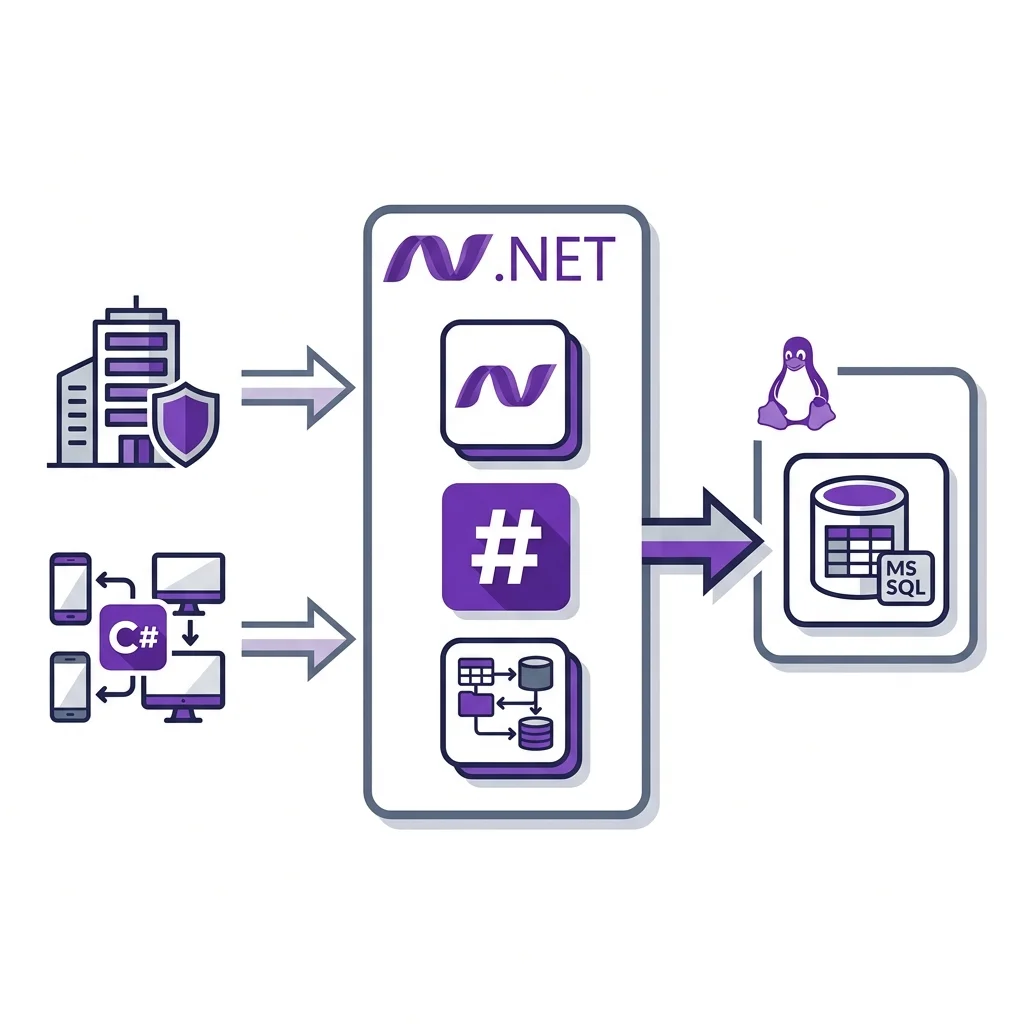
Modern .NET Architecture: Open-source, cross-platform ASP.NET Core and Entity Framework Core.
Event-Driven Streaming and Big Data
As systems scale, direct point-to-point HTTP calls become fragile bottlenecks. Decoupling services using Apache Kafka ensures reliable, distributed event logging. For telemetry analytics and large-scale SIEM ingestion, combining Kafka with Apache Spark represents the pinnacle of data pipeline engineering.
DevSecOps and Infrastructure: From Pipeline to Global Edge
How application code is validated, compiled, and published is as critical as the code itself.
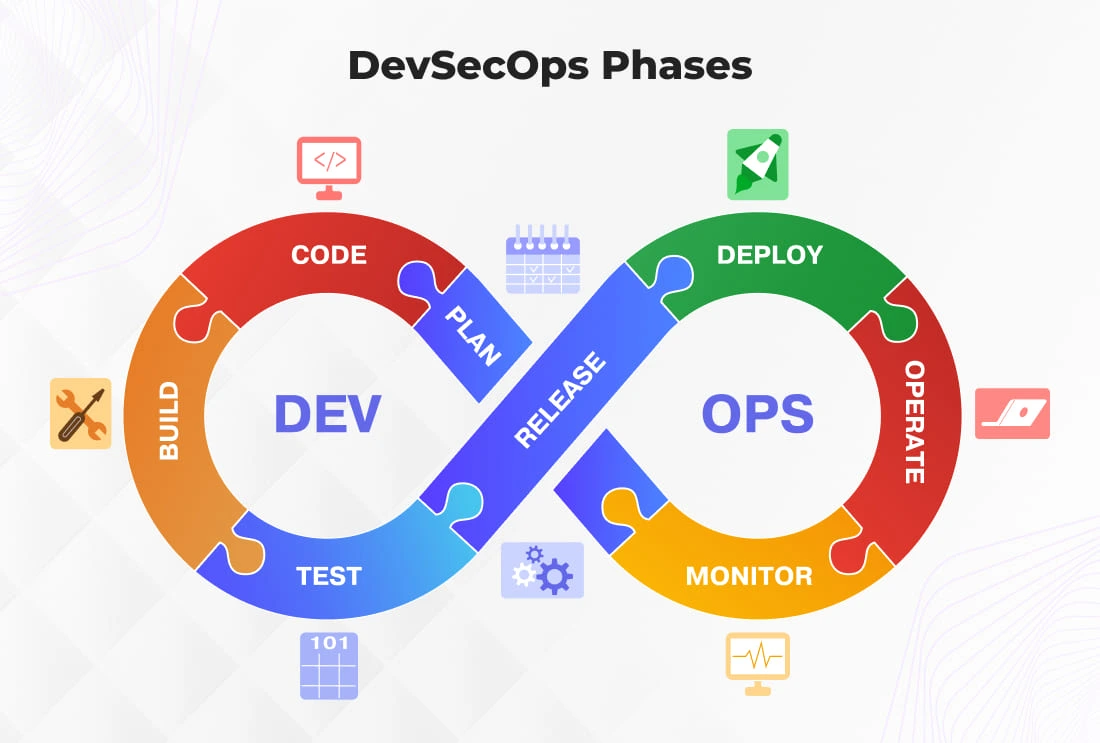
DevSecOps integration across CI/CD pipelines: Build, Scan, and Deploy verification.
Software Supply Chain Security
Modern web frameworks pull in thousands of transitive dependencies. Recent account takeovers and malicious package drops across the NPM ecosystem highlight that dependencies are often your weakest security link:
- Strict Lockfile Pinning: Commit
package-lock.jsonorpnpm-lock.yamlto prevent unauthorized upstream version resolution. - Automated SBOM Generation: Produce CycloneDX or SPDX Software Bills of Materials on every build, scanning components with
TrivyorGrype. - Secret Leak Prevention: Enforce Git hooks and GitHub Actions workflows using
GitLeaksandTruffleHogto prevent API keys and database credentials from leaking into Git history.
Edge Computing and Cloudflare Zero Trust
Deploying static and hybrid frontends via Cloudflare Pages connects directly to Git repositories, compiling and distributing code to global edge caches in seconds.

Cloudflare architecture: Serving assets from global edge caches without origin servers, shrinking the attack surface.
Running logic on Cloudflare Workers evaluates WAF rules long before traffic reaches application origins. For internal admin tooling, integrating Cloudflare Zero Trust removes the need for legacy VPNs, requiring mutual identity verification before granting access to protected services.
Common Anti-Patterns in Web Engineering
Pitfalls to avoid when designing modern architectures:
- "Make Everything SSG": Attempting to force real-time streaming data (like live stock ticks) into static builds introduces brittle workarounds. Use ISR or WebSocket connections instead.
- "Changing Frameworks Automatically Solves Performance": Switching frameworks without image optimization (WebP/AVIF), font subsetting, and strict JavaScript budgets will not improve Core Web Vitals.
- "We'll Address Security Later": Postponing dependency scanning and secret audits until production release invites critical breaches.
- "SEO Is Just Meta Tags": Overlooking server-side response times, canonical tags, structured JSON-LD schemas, and crawlability will stifle organic reach regardless of framework speed.
There is no universal "best tool" in web engineering—only the right architectural match for your project's data velocity, team capacity, and security posture. Balancing the dynamic power of PERN and Next.js for e-commerce with rigorous CI/CD pipeline scans, while leveraging Astro, Hugo, and Cloudflare Pages for fast, secure static sites, is the defining hallmark of modern web architecture.